Mattias Stahl: vibraphone
Magnus Broo: trumpet
Mats Aleklint: trombone
Martin Küchen: alto saxophone
Johan Berthling: double bass
Kjell Nordeson: drums
Editor's info:
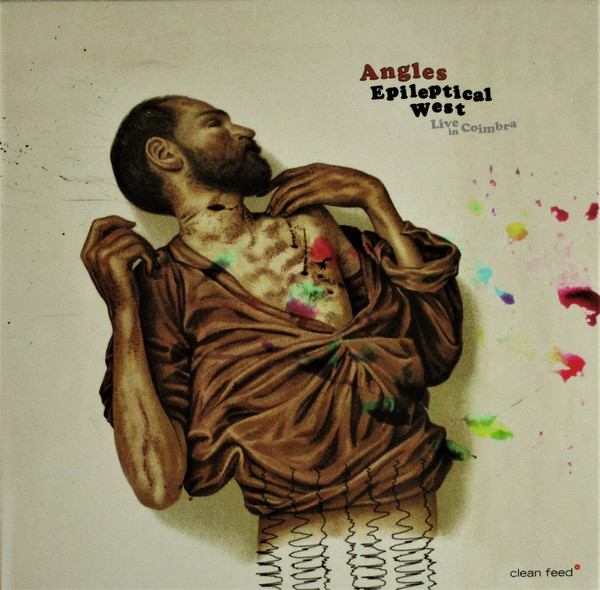
Martin Küchen is naive and desperate, and maybe only because of that one might feel that each of his albums has a message. If this message may seem political, its sense is profoundly about human undertakings, and "Epileptical West", recorded live in Coimbra, Portugal, during the Jazz ao Centro festival, is no exception. Born in Sweden with a German father with a mixed background , he's known not only for his innovative saxophone playing (going from the soprano to the baritone, here centered on the alto) and his ear-catching compositions, but also for his very critical statements regarding the Israeli and the American policies in relation to Palestine and the Palestinians. Music is, for the Angles leader, a medium for and to itself, but also for a clearance of thought and for the in- and outlook of the world - and therefore it can be metaphysical devoted to denounce the "global lie" covering "the terror society of the individual in which we live". With a jazz oriented musical education, but former dedications to rock and klezmer, Küchen became interested in African music, specially the one he discovered in Guinea, and in non-idiomatic, free improvised music, a field in which he developed astonishing new techniques. All those experiences are reflected in the music we find here: it's jumpy, polirhythmic and with a refined world music accent, somehow remembering Fela Kuti's Afro-Beat, and it's very melodic, with phrasings you can sing along. The format goes from the most energetic free bop, sustained by the always unquiet propulsion work ofered by Johan Berthling on the double bass and Kjell Nordeson on the drums, and with a powerful blowing section completed by trumpeter Magnus Broo and trombonist Mats Aleklint, to the abstract situations, either delicate or near-chaos, in which the remarkable vibraphonist Mattias Stahl finds space to shine like only himself can do. From this results something that makes you tap your feet and at the same time use ....... more
JazzAbout:
"...Skandynawski sekstet Angels wydał właśnie drugi album w swojej niezbyt długiej historii i jest to moim zdaniem najważniejsza płyta wydana w pierwszych miesiącach tego roku. Muzyka odwołuje się zarówno do tradycji jazzowej jak i awangardy, a zebrani tu muzycy dali się poznań w wielu różnych (pod względem muzycznej prowieniencji) składach (odwołujące się do skrajnego free Trinity Martina Kuchena czy AALY Trio i Sten Sandell Trio, raczej jazzowego mainstremu Atomic i 4 Corners z Magnusem Broo czy też czerpiące z tradycji noise'u Fire! z Johannem Berthlingiem). Sekstetowe granie czerpie po troszku ze wszystkich tych wątków, chociaż, mam wrażenie, że najwięcej odwołuje się do pograniczy obu jazzowych tradycji - free i mainstreamu, wykorzystując w tym względzie doświadczenia słynnych zespołów lat sześćdziesiątych - sekstetu Charlesa Mingusa i Erica Dolphy'ego. Tradycja objawia się tu formie kompozycji, swingujących tematach Kuchena (co zaskakujące, wszystkie kompozycje są jego autorstwa - osobiście kojarzyłem go bardziej z awangardowymi projektami czy nawet ze sceną free improv), natomiast forma grania i interpretacja jest otwarta - mam wrażenie, że dużo bardziej niż w Atomic. Sam Kuchen - jako muzyk związany z wieloma, wieloma nurtami (od rocka i muzyki klezmerskiej na afrobeacie kończąc) - zasługuje zresztą na osobną monografię. W muzyce Angels nie ma jednak odwołań do rocka i motorycznych formuł znanych z Vandermark 5. Wszystko, co wydarza się tutaj pozostaje w obrębie jazzu. Znakomite granie dla wszystkich miłośników gatunku!"
autor: Marcin Zając










 serpent.pl /
shop /
latest /
special offers /
new /
recommended /
labels /
artists /
bestsellers /
shipping costs /
help /
terms and conditions /
contact
serpent.pl /
shop /
latest /
special offers /
new /
recommended /
labels /
artists /
bestsellers /
shipping costs /
help /
terms and conditions /
contact