muzycy:
Tom Chiu: Violin
Jennifer Choi: Violin
Olivia De Prato: Violin
Erik Friedlander: Cello
Joyce Hammann: Violin
William Winant: Percussion
Kathryn Andersen: Violin
Sam Armstrong: Trombone
Doug Balliett: Bass
Brad Balliett: Bassoon, Contra Bassoon
Scott Bartucca: Oboe, English Horn
Steven Beck: Piano, Harpsichord, Celeste, Organ
Nathan Botts: Trumpet
Meghan Burke: Cello
Jay Campbell: Cello
Erik Carlson: Violin
Jon Carroll: Horns
Claire Chase: Piccolo, Flute, Alto And Bass Flute
Caroline Chin: Violin
Barry Crawford: Piccolo, Flute, Alto And Bass Flute
Owen Dalby: Violin
Elizabeth Derham: Violin
Rachel Drehmann: Horns
Wayne Dumaine: Trumpet
Brian Ellingsen: Bass
Peter Evans: Trumpet
Felix Fan: Cello
Kenn Finn: Trombone
Gareth Flowers: Trumpet
David Fulmer: Conductor
Gillian Gallagher: Viola
Emilie-Anne Gendron: Violin
Matthew Gold: Percussion
Stephanie Griffin: Viola
Christopher Gross: Cello
William Hakim: Viola
Ken Hamao: Violin
Conrad Harris: Violin
Rebekah Heller: Bassoon, Contra Bassoon
Jen Herman: Viola
Zachary Hobin: Bass
Nicole Jeong: Violin
Bridget Kibbey: Harp
Pauline Kim: Violin
Sooyun Kim: Piccolo, Flute, Alto And Bass Flute
William Knuth: Violin
Adda Kridler: Violin
Yon Joo Lee: Violin
Alicia Lee: Clarinet, Bass Clarinet
Alex Lipowski: Percussion
Victor Lowrie: Viola
Clara Lyon: Violin
Campbell MacDonald: Clarinet, Bass Clarinet
Kevin McFarland: Cello
Carol McGonnell: Clarinet, Bass Clarinet
Joshua Modney: Violin
Arthur Moeller: Violin
Rane Moore: Clarinet, Bass Clarinet
Adrian Morejon: Bassoon, Contra Bassoon
Dave Nelson: Trombone ......... more
www.popmatters.com; ocena: Reviewer Rating: 7/10:
A man at a crossroads and an enjoyable effort.
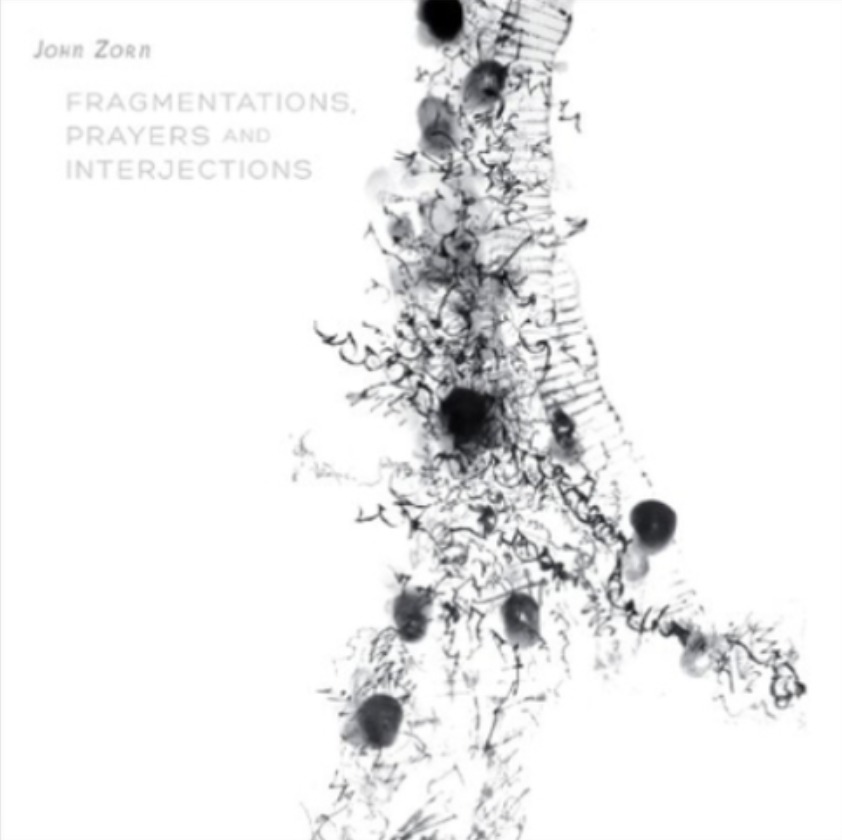
Darius Milhaud’s polytonality and Shostakovich’s cynicism seem to welcome the listener as they approach John Zorn’s latest effort, while Jacques Ibert’s perennial state of unrest and irony, quietly (albeit not silently) lurk in the background. As peculiar as the thought might sound, avant-garde can sometimes revel in vintage clothes, toy with retroactivity, instigate a certain eagerness for obsoleteness and still sound quintessentially fresh. Fragmentations, Prayers & Interjections is certainly a fine example of this contradiction. It is an inspired work which vouches for Zorn’s maturity and sophistication, while at the same time it is a testimony of his detachment from the purity of musical unpredictability and improvisation. The Arcana Orchestra, lead by David Fulmer, take on the challenge. The final result? An accurate rendition of Zorn’s musical paradigm.
The rich musical assortment on display is introduced by the now legendary “Orchestra Variations”: a piece commissioned by the New York Philharmonic back in 1996 and performed for the first time in 1998 with Leonard Slatkin on the podium. The five or so minutes of atonality and subtle allusions to Stravinsky’s genius are somehow reminiscent of Zorn’s early infatuation with Olivier Messiaen and Arnold Schoenberg, but the overall impression is one of incompleteness, as if one could not help but feel that the carefully constructed dynamics of the piece would not be out of place in a more structured and articulated composition.
Ironically, “Contes de Fées” – a work composed three years later – presents itself as its ideal continuum, with Chris Otto’s violin leading the orchestra into twirls and dramatic rumbles, while still managing to keep a delicate balance between the soloist ....... more
Nieoczekiwane, nowe oblicze Johna Zorna
Pierwsza orkiestrowa płyta Johna Zorna od piętnastu lat. Cztery kompozycje, napisane na duże składy, wśród nich legendarna "Orchestra Variations" (1996) zamówiona przez New York Philharmonic i "Suppots et Suppliciations" (2012) powstałe na zamówienie BBC Symphony, a inspirowane późnymi pracami Antonina Artauda. „Fragmentations, Prayers And Interjections” to cztery różnorodne utwory powstałe w latach 1996-2012, które są niezłym przeglądem przez stany duchowe i muzyczne Zorna.
Największe wrażenie robi na mnie "Kol Nidre" 1996 na orkiestrę smyczkową. Słychać tu echa muzyki neo-sakralnej z drugiej połowy XX wieku. Odwołania do Arvo Parta są uzasadnione. Powolne, powracające zmiany akordu jak w rytm jakiegoś utajonego rytuału, wszystko eteryczne i zmysłowe, niemalże przezroczyste.
Z drugiej strony może zachwycać rozmach "Orkiestrowych Wariacji" i “Suppots et Suppliciations", 83 osobowa orkiestra, złożona z przedstawicieli śmietanki nowojorskiej bohemy artystycznej wydaje się być idealnie dostrojona o synkretycznej, kompozytorskiej wizji Johna Zorna.
autor: Jarosław Lisiak
www.popmatters.com; ocena: Reviewer Rating: 7/10:
A man at a crossroads and an enjoyable effort.
Darius Milhaud’s polytonality and Shostakovich’s cynicism seem to welcome the listener as they approach John Zorn’s latest effort, while Jacques Ibert’s perennial state of unrest and irony, quietly (albeit not silently) lurk in the background. As peculiar as the thought might sound, avant-garde can sometimes revel in vintage clothes, toy with retroactivity, instigate a certain eagerness for obsoleteness and still sound quintessentially fresh. Fragmentations, Prayers & Interjections is certainly a fine example of this contradiction. It is an inspired work which vouches for Zorn’s maturity and sophistication, while at the same time ....... more










 serpent.pl /
shop /
latest /
special offers /
new /
recommended /
labels /
artists /
bestsellers /
shipping costs /
help /
terms and conditions /
contact
serpent.pl /
shop /
latest /
special offers /
new /
recommended /
labels /
artists /
bestsellers /
shipping costs /
help /
terms and conditions /
contact