muzycy:
Tetsu Saitoh - double bass
Frederic Blondy - grand piano
Michel Doneda - soprano and sopranino saxophones
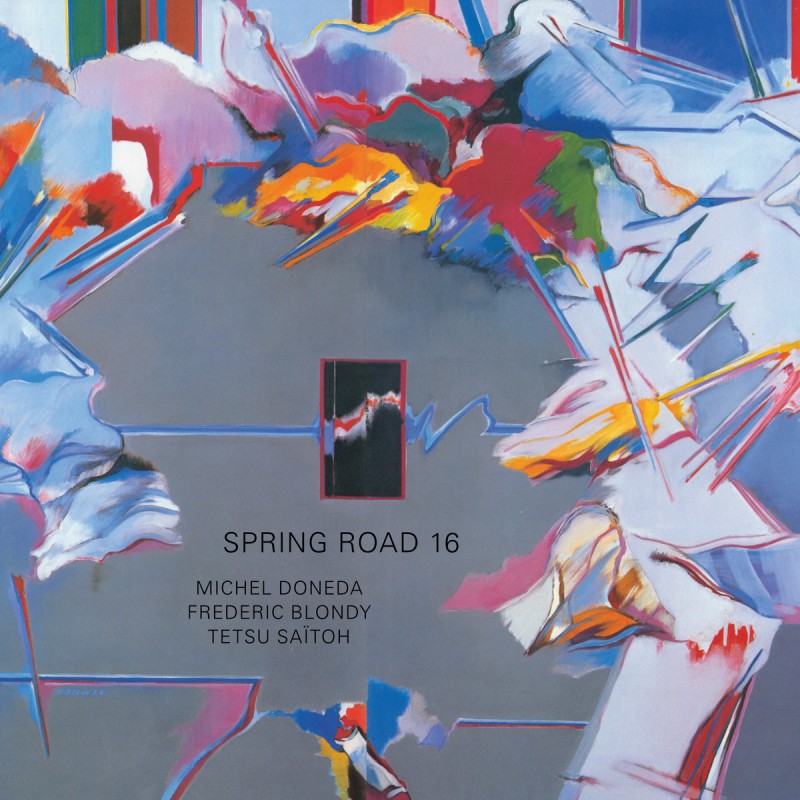
Hyokichi Onari - cover painting
Editor's info:
French soprano saxophonist Michel Doneda is recognized as a leading avant-garde, experimental, and free jazz improviser. He has been performing with legendary Japanese bassist Tetsu Saitoh for 30 years. On this recording they are joined by French pianist Frederic Blondy.
Sadly, this was to be their final document, a recording from Radio France before Tetsu's premature death. This recording is an incandescent dance that united Tetsu Saitoh, Michel Doneda and Frederic Blondy on the stage of the France Musique studio. It is a moment of music that brings together three fellow bodies, three sensibilities, three histories, and also three musical instruments taken as a whole, their multiple points of passage, their most intimate and savage correspondences.
Michel Doneda provides some of the ferocious moments on this record. Whether blowing on his soprano or his sopranino, his technique is recognizable articulate blowing that doesn't overpower the rest of the trio, but enhances its colors.
Liner Notes
Michel Doneda recently lost one of his most faithful friends and musical companions, the double bass player Tetsu Saitoh. Relative Pitch now offers us a superb album recorded on April 16, 2016 on Radio-France bringing together the two improvisers and the remarkable piano explorer Frédéric Blondy. Spring Road 16 is comprised of two collective improvisations under the title of No Road part 1 and No Road part 2. The name Spring Road has been part of their peregrinations as a duo since the first recording Doneda / Saitoh (Spring Road 01 / Scissors 01), because, without a doubt, it was a spring enterprise just like this new album recorded at the beginning of spring when nature and emotions are reborn, the title No Road is quite relevant, as their sound investigations bring together a multitude of paths, reflections, sounds: we are in an unknown territory even if these artists have been exploring continuously ....... more
Doneda, Blondy i być może ten najważniejszy – Saitoh! Niespełna 39 minut muzyki, która na pewno zagości na naszym rocznym podsumowaniu płyt wybitnych a.d. 2021! Here we go!
Ceremonia otwarcia spoczywa na barkach masywnego kontrabasu, który od startu buduje jakby dwie narracje. Z jednej strony ryje bruzdy w ziemi smyczkowym dronem, z drugiej rysuje zmysłowe, lekkie, zadziorne frazy arco. Czy muzyk gra tu dwoma smyczkami, czy ma trzecią rękę, niech pozostanie tajemnicą tych, którzy widzieli ową rejestrację w pieleszach paryskiego studia nagraniowego. Saitoh nie zawłaszcza jednak całej przestrzeni tej definitywnie bardzo swobodnej narracji, pozostawia bowiem miejsce na lekki, frywolny sopran Donedy i mikro ekspozycje Blondy’ego na gołych strunach fortepianu. Narracja płynie wartkim strumieniem - na gryfie kontrabasu (który niepodzielnie rządzi sceną!) ciągłe zmiany sposobu maltretowania strun, saksofon skacze i opada, ale mimo swej pozornej lekkości, wciąż kąsa intrygującymi frazami, piano zaś dobrze się czuje w roli cerbera dramaturgicznego ładu i koherentności parametrów dynamiki improwizacji. Opowieść pulsuje intensywnością, ale bez trudu wpada też w nastrój melancholii, refleksji i egzystencjalnego oddechu.
Tymczasem narracja bez sekundy przerwy przenosi nas do drugiej części płyty. Muzycy na ten czas serwują nam piękną chwilę dramaturgicznego suspensu. Kontrabas piszczy jak kot wysokim arco, drży i szeleści, by po chwili rwać włosy z głowy post-jazzowym pizzicato. Saksofon konsekwentnie charczy i skrzypi, piano zaś wciąż w trybie minimal, duma nad losem steranej ludzkości. Tuż potem następuje krótka faza imitacji saksofonu i smyczka, ale znów z basowym tłem pełnym mrocznych odcieni. Emocje rosną, z każdej strony sceny wieje grozą, a etykieta acoustic industrial wcale nie wydaje się złym określeniem tego momentu opowieści. Zresztą zmiana goni tu zmianę, jak na karuzeli. Nagle kontrabas wchodzi w ostry tryb pizzicato i ciągn....... more










 serpent.pl /
shop /
latest /
special offers /
new /
recommended /
labels /
artists /
bestsellers /
shipping costs /
help /
terms and conditions /
contact
serpent.pl /
shop /
latest /
special offers /
new /
recommended /
labels /
artists /
bestsellers /
shipping costs /
help /
terms and conditions /
contact