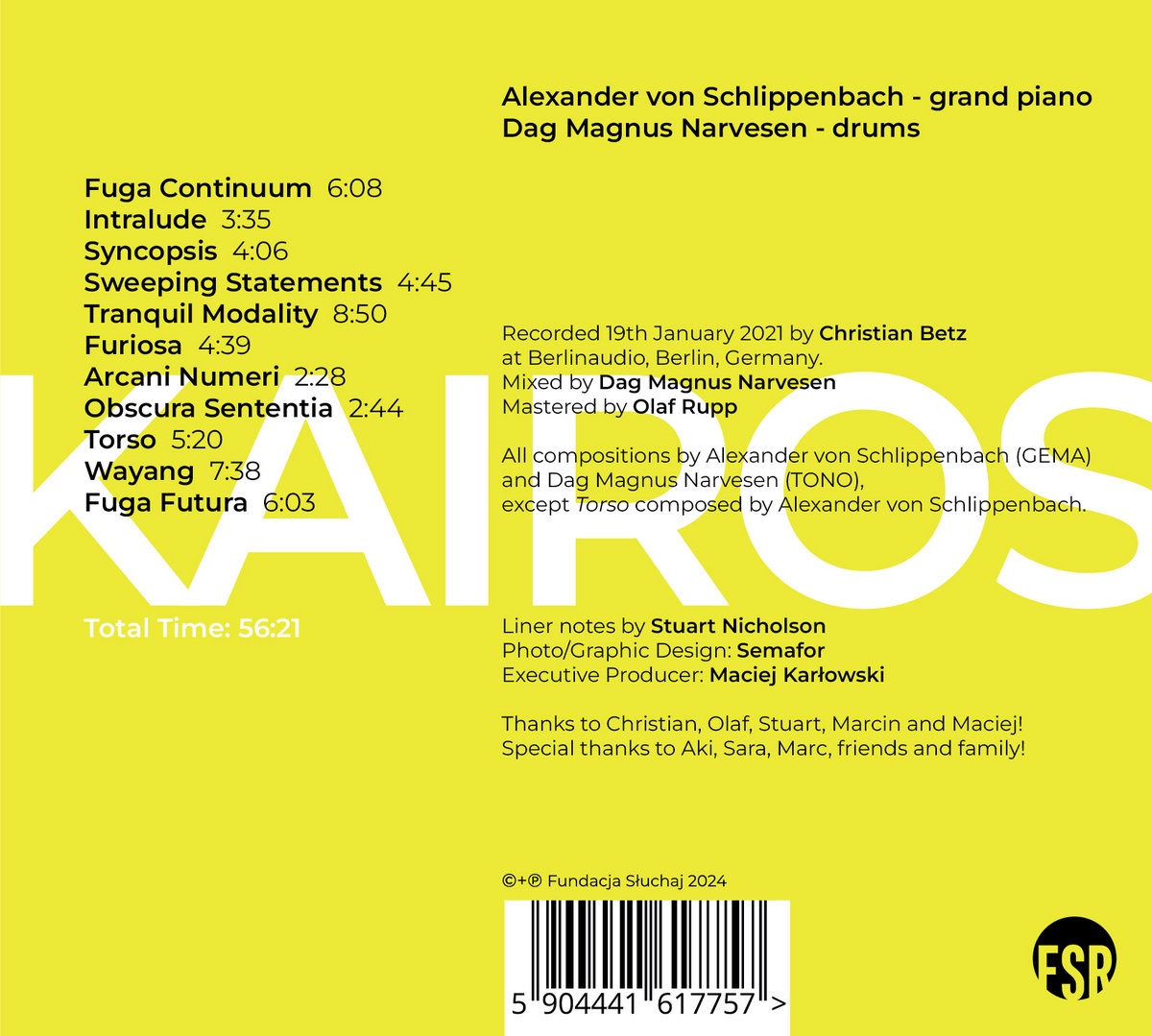
Alexander von Schlippenbach - grand piano
Dag Magnus Narvesen - drums
Recorded 19th January 2021 by Christian Betz at Berlinaudio, Berlin, Germany.
Mixed and edited by Dag Magnus Narvesen. Mastered by Olaf Rupp.
It has been claimed, not without justification, that no new creation in the arts can claim to be outside the tradition, as the tradition eventually expands to absorb everything artists do. It’s almost seventy years since Ornette Coleman walked through the door marked free jazz, and what was once seen as daring, outré and avant garde is now regarded as an established part of the jazz tradition. It is a tradition that is largely debated and communicated in terms of leading American musicians, even today. Yet by the late sixties, shrewd commentators such as Ekkehard Jost in Germany and Max Harrison in London were arguing that certain free jazz musicians in Europe were working towards creating their own original, yet specifically European, version of free jazz.
As early as 1963, Albert Mangelsdorff’s liner notes for his debut album Tension, had urged European musicians to make more use of the term freedom to express their European identity. Others too were working along similar lines. Gunter Hampel’s Heartplants featured pianist Alexander Schlippenbach’s conceptual compositions contrasting structure and freedom, ideas explored over a broader canvas when he founded the Globe Unity Orchestra.
Schlippenbach was one of a select band of European free musicians who were inspired by, but not seeking to emulate, the sounds of free jazz from the New World. Leading European free jazz musicians, detached from the cultural and political undertow of American free jazz seemed to realise early on that total freedom could ultimately be limiting. The answer was to structure the free, that there need be no conflict between free and structured jazz, the challenge was how to manage methods of construction and de-construction, a challenge Schlippenbach had begun to follow early on to define his approach to improvised music.
The resolute individuality of ‘Sun,’ from Globe Unity, employed a “structural jazz” approach to free....... more












 serpent.pl /
shop /
latest /
special offers /
new /
recommended /
labels /
artists /
bestsellers /
shipping costs /
help /
terms and conditions /
contact
serpent.pl /
shop /
latest /
special offers /
new /
recommended /
labels /
artists /
bestsellers /
shipping costs /
help /
terms and conditions /
contact