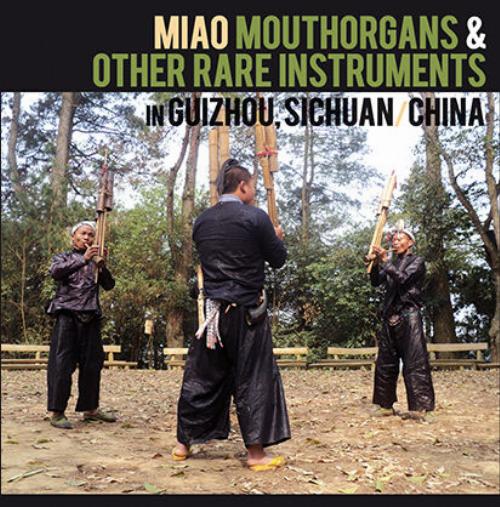
The term MIAO is a very ancient Chinese misleading pseudo-ethnic categorisation, what we call the HMONG in western languages, a term recognised by colonial French Indochina. Miao became a generic term which does not reveal the diversity of 38 subgroups or 9 million people, mostly in Southern China Guizhou Province.
China having moved towards the market economy, a large number of minority regions have marketed a commodity available only to them: their ethnicity itself. Ethnic tourism has developed in a big way in China since the 1990s for Chinese and foreign tourists, and is often promoted as the way to create income in those areas for development. I usually stay away from ethnotouristic shows and try to get music which is not a commodity! I was based in Dali. Yunnan. China between 2006 and 2013.
RECORDED BY LAURENT JEANNEAU & SHI TANDING
NOTES BY LAURENT JEANNEAU
A1 MIAO THREE MOUTHORGANS IN GUIZHOU CHINA
Three men each using a different size LUSHEN or GUÉ and four women each blowing in a different MANTONG. Recorded in Paisha village, home of a mouth organ manufacturer.
A2 HUA MIAO WEDDING DANCE IN SICHUAN CHINA
The main music instrument is LUSHEN, the predominant kind of mouth organ being used for entertainment, where the long tubes lushen mounted on a wooden resonance box is here used only for funerals.
A3 HMOOB DONGLIANG IN GUIZHOU CHINA
Recorded in Biasha village, which has recently turned into what i call an ethnic zooŠ Luckily, we found some musical expression which is not part of this touristic fashion, a more intimate set up composed of two reeds instruments (DONGLIANG is a bamboo flute with a copper reed inserted in the mouth and requires circular breathing
technique ) and male and female singers, intended as love songs.
B1 HUA MIAO HULUSHEN IN SICHUAN CHINA
Performed by a one man. The main music instrument is the small mouth organ, HULUSHEN is the pr....... more










 serpent.pl /
shop /
latest /
special offers /
new /
recommended /
labels /
artists /
bestsellers /
shipping costs /
help /
terms and conditions /
contact
serpent.pl /
shop /
latest /
special offers /
new /
recommended /
labels /
artists /
bestsellers /
shipping costs /
help /
terms and conditions /
contact