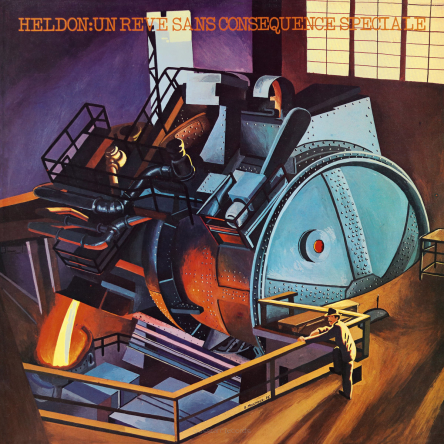
Heldon's Richard Pinhas has never been shy of pinpointing his influences while, at the same time, making music that is noticeably distinct from any of his designated sources. He has, for instance, made it clear that a significant font of inspiration was Robert Fripp's guitar style and melding of rock music with cutting-edge electronics (especially in collaboration with Brian Eno). Indeed, Heldon's fifth album - 1976's Un Rêve Sans Conséquence Spéciale - was named after a live bootleg of a King Crimson concert.
Pinhas first met Fripp in 1974. The pair became friends, and have remained in contact ever since. Pinhas was even offered a deal with E.G. Records, the company that oversaw King Crimson alongside other successful groups like Roxy Music and ELP. "That was a dream," says Pinhas. "But when you are 22, you are in a hurry. They asked me to wait one or two years before joining the team. I couldn't wait two years! At 22, two years is too much."
Instead, Pinhas forged another path. He launched his own label, Disjuncta, which he later sold to purchase the Moog synthesiser that would make a huge difference to Heldon's sound. inhas ake a huge difference to Heldon'#s n beard of Daniel P Carterd, hem with open arms, a bottle of agnet 's sound.The instrument's previous owner happened to be Paul McCartney. "We didn't see McCartney", Pinhas says of his shopping trip to the UK. "We just dealt with The Beatles' technical guys. At this time, we learned it was McCartney's Moog. So what? It was very rare to get one. It was expensive. I love The Beatles, but to be honest I prefer John Lennon."
Musical benchmarks aside, Heldon's output also drew from radical science fiction (Philip K. Dick, Norman Spinrad, etc.) as well as philosophy. The sleeve of the fifth LP features a quote from Pierre Klossowski's Nietzsche and the Vicious Circle (1969). The book had profound impact on thinkers such as Jean-François Lyotard, who was Pinhas' PhD supervisor at the So....... więcej


 NOŚNIKI







 serpent.pl /
sklep /
ostatnio dodane /
promocje /
nowo?ci /
polecamy /
wydawcy /
wykonawcy /
bestseller /
koszty wysy?ki /
pomoc /
regulamin /
kontakt /
serpent.pl /
sklep /
ostatnio dodane /
promocje /
nowo?ci /
polecamy /
wydawcy /
wykonawcy /
bestseller /
koszty wysy?ki /
pomoc /
regulamin /
kontakt /