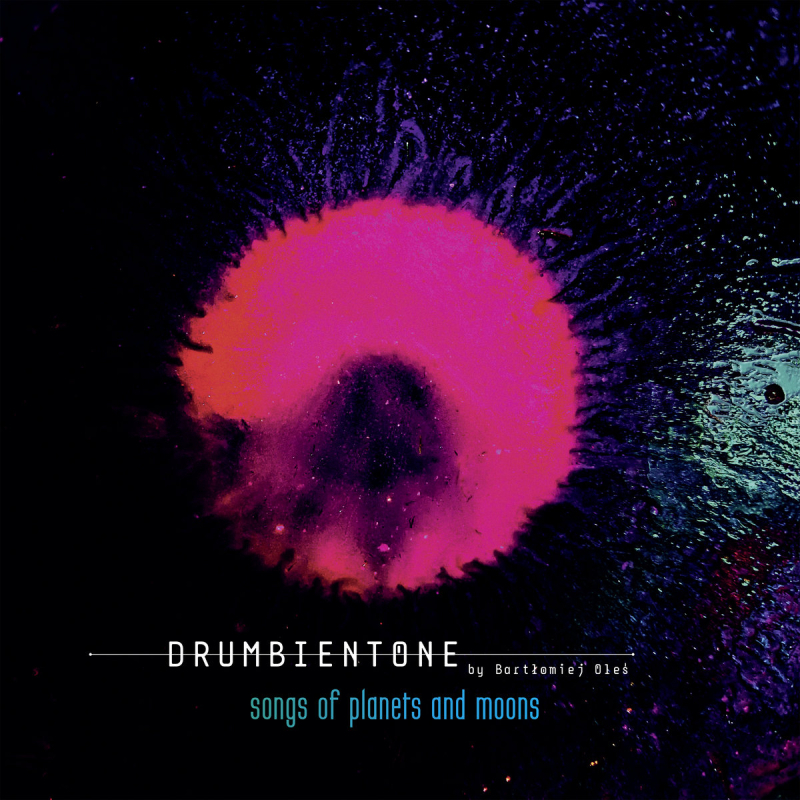
The story of the creation of the album "Songs of Planets and Moons" begins when I first heard the sounds recorded by the Cassini and Voyager 1 & 2 probes, the result of deep space exploration. These unmanned spacecraft record all the information they encounter on their way, including the electromagnetic vibrations of the planets, which are then processed into sounds audible to the human ear. These sounds fascinated me to such an extent that I chose nineteen of them to create music based on their sounds, processing them electronically and adding my own musical comments and structures. The whole thing creates a kind of sonorous expedition to the distant corners of the universe, sometimes far beyond the solar system.
It begins with Gliese 581 c, an extrasolar planet of the super-Earth type orbiting the red dwarf Gliese 581, located in the constellation of Libra about twenty light years from Earth - which is astronomically a very small distance. Gliese 581 is 89th on the list of the closest star systems to Earth. The next celestial object is the extrasolar super-Earth planet GJ 1214 b, orbiting the star GJ 1214 located in the constellation Ophiuchus at a distance of 13 parsecs or 42.40032910028 light years from Earth, it has a diameter of about 2.7 times larger than Earth. It is composed largely of water and probably hydrogen. GJ 1214 b is considered the best candidate for an ocean planet. Kepler 22b is also an extrasolar planet located in the habitable zone of a star similar to the Sun. The planet has a diameter of 2.4 times larger than Earth and is located about 600 light years from the Solar System in the constellation Cygnus. Its mass and density are not known, so it is not known whether it resembles the rocky Earth in structure, we know that it orbits the star Kepler-22 in 290 days. Proxima Centauri b (Proxima b) is an extrasolar planet of the terrestrial type orbiting the star Proxima Centauri. Its star is a component of the triple system Alpha Cent....... more
Historia powstania albumu „Songs of Planets and Moons” zaczyna się w momencie, kiedy po raz pierwszy usłyszałem, brzmienia zarejestrowane przez sondy Cassini oraz Voyager 1 & 2, będące wynikiem badania dalekiego kosmosu. Te bezzałogowe statki kosmiczne rejestrują wszystkie napotkane na swojej drodze informację, w tym drgania elektromagnetyczne planet, które są następnie przetwarzane na dźwięki słyszalne dla ludzkiego ucha. Dźwięki te zafascynowały mnie do tego stopnia, że wybrałem dziewiętnaście z nich by stworzyć muzykę w oparciu o ich brzmienia, przetwarzając je elektronicznie oraz dodając od siebie swego rodzaju muzyczne komentarze oraz struktury. Całość tworzy swoistą sonorystyczną wyprawą w odległe zakątki wszechświata, momentami daleko poza układ słoneczny.
Rozpoczyna ją Gliese 581 c planeta pozasłoneczna typu super-ziemia orbitująca wokół czerwonego karła Gliese 581, znajduje się w gwiazdozbiorze Wagi około dwadzieścia lat świetlnych od Ziemi – co astronomicznie jest odległością bardzo małą. Gliese 581 zajmuje 89 miejsce na liście najbliższych układów gwiezdnych względem Ziemi. Kolejny obiektem niebieskim jest pozasłoneczna planeta typu super-ziemia GJ 1214 b, krążąca wokół gwiazdy GJ 1214 znajdującej się w gwiazdozbiorze Wężownika w odległości 13 parseków czyli 42.40032910028 lat świetlnych od Ziemi, ma ona średnicę ok. 2,7 raza większą niż Ziemia. W znacznej części składa się z wody oraz prawdopodobnie wodoru. GJ 1214 b jest uważana za najlepszą kandydatkę na planetę oceaniczną. Kepler 22b to również planeta pozasłoneczna znajdująca się w ekosferze gwiazdy podobnej do Słońca. Planeta ma średnicę 2,4 razy większą od Ziemi i znajduje się około 600 lat świetlnych od Układu Słonecznego w gwiazdozbiorze Łabędzia. Jej masa, ani gęstość nie są znane, nie jest zatem wiadome, czy przypomina ona budową skalistą Ziemię, wiemy że obiega gwiazdę Kepler-22 w czasie 290 dni. Proxima Centauri b (Proxima b) to planeta pozasłoneczna typu ziem....... more










 serpent.pl /
shop /
latest /
special offers /
new /
recommended /
labels /
artists /
bestsellers /
shipping costs /
help /
terms and conditions /
contact
serpent.pl /
shop /
latest /
special offers /
new /
recommended /
labels /
artists /
bestsellers /
shipping costs /
help /
terms and conditions /
contact